

Research underpins the work of the Foundation and allows us to make informed decisions based on evidence, pushes the boundaries of what we know, helps us to understand more clearly the state of play and what we should be focussing on and provides us the opportunity to support evidence-based programs. Research drives innovation and is critical for practical problem solving.
RESEARCH
DRIVING
INNOVATION
THROUGH
RESEARCH
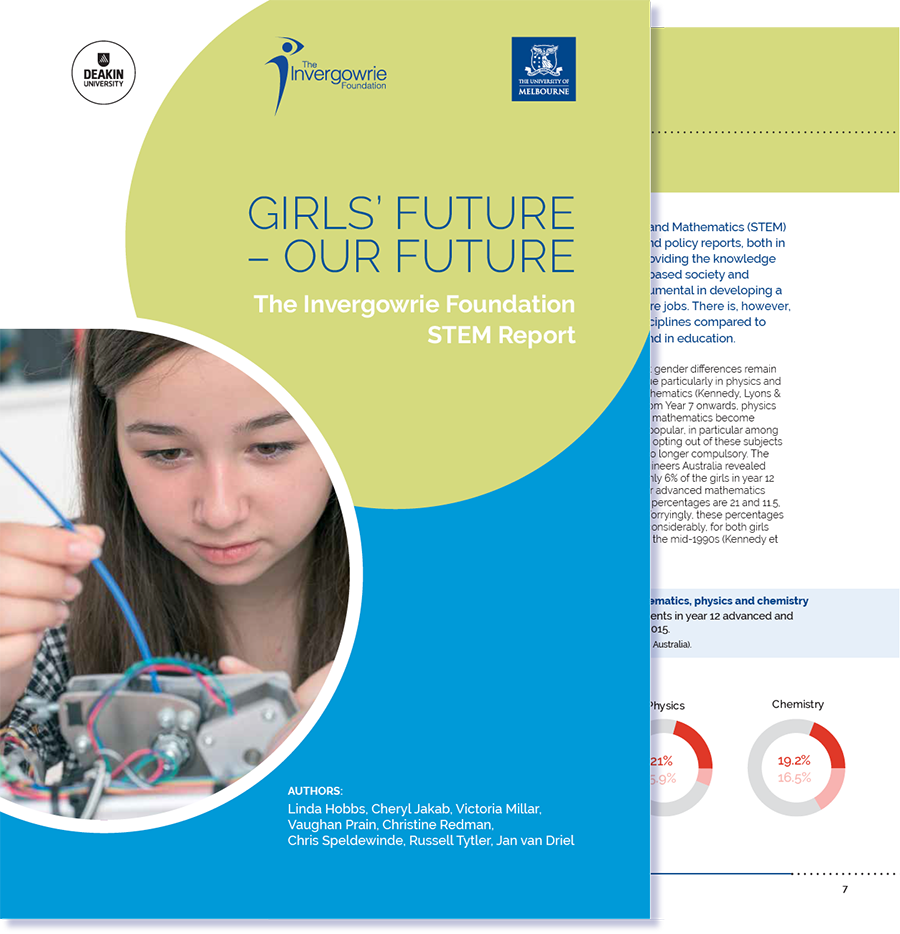
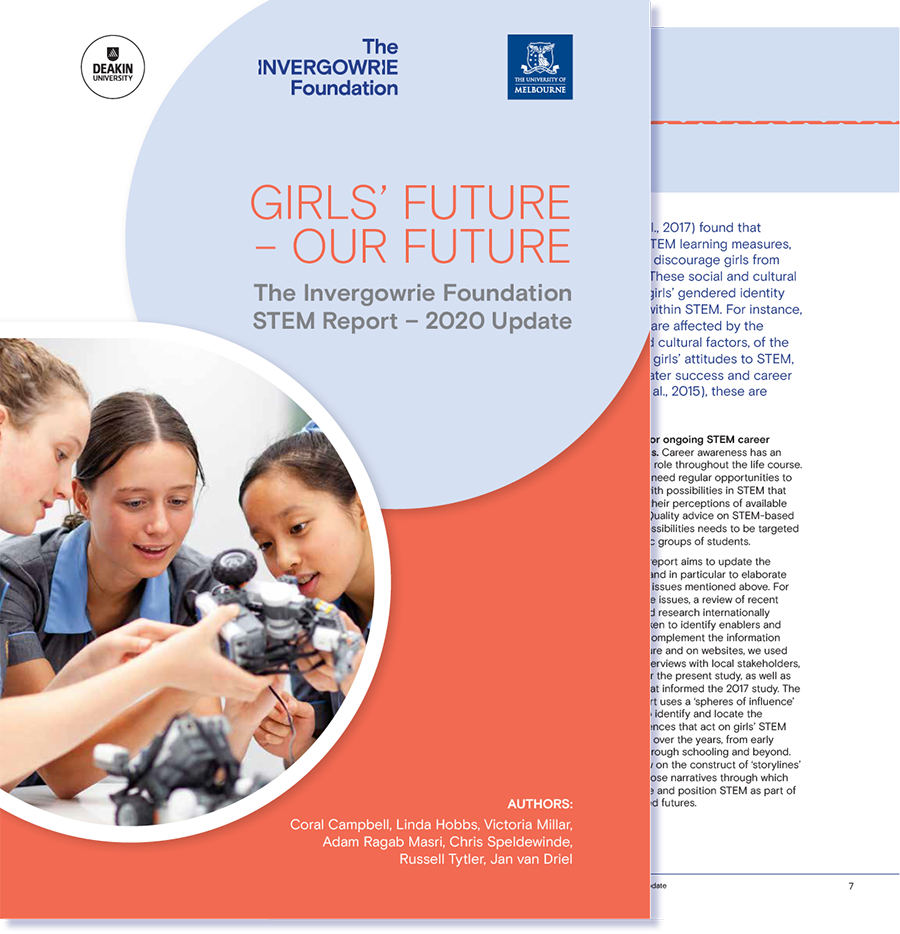
The Foundation has commissioned its own research into identifying the factors that influence students’ engagement in STEM education with a particular focus on barriers faced by girls. Girls’ Future – Our Future, the Invergowrie Foundation STEM report was launched in 2017 followed by an update in 2020.
RESEARCH BACKED PROGRAMS
A number of the programs the Foundation currently supports are backed by comprehensive research that informs the direction of the programs so as to achieve the desired outcomes.
STEMeez
STEMeez is an innovative online platform designed to make learning about Science, Technology, Engineering and Mathematics (STEM) accessible, engaging, and part of everyday life. Some of the papers and studies that have shaped the project are listed here.
A Systematic Review of the Role of Multimodal Resources for Inclusive STEM Engagement in Early-Childhood Education
This paper presents the findings from a systematic review of 29 websites and 13 frameworks that provide STEM (Science, Technology, Engineering, Mathematics) educational resources for parents, educators, and children (birth–8 years of age). Our theoretical approach is rooted within a social semiotic perspective that has indicated that multimodality enables children to use different types of expression to communicate a message or share an idea. Using the PRISMA methodology and the narrative document analysis approach, the themes that emerged included how the content and resources available on the websites addressed whether multimodality supported STEM engagement in an inclusive manner. The findings revealed that there were scarce multimodal resources that engaged children with fun, interactive, and meaningful opportunities to be autonomous learners (e.g., children had agency) (n = 11 out of 29), moving between the digital and hands-on physical spaces (n = 8 out of 29), employing gamification for deep learning (n = 4 out of 29), and piquing children’s imagination, inquiry, and creativity, and links to everyday STEM scenarios were hardly present (n = 10 out of 29). The implications lie in addressing early STEM engagement by considering children’s learning abilities and agency, bearing in mind parents/educators’ sociocultural backgrounds, confidence in STEM awareness, and multimodal avenues for communicating STEM learning and inquiry.
Gender and STEM: Rethinking an issue that refuses to resolve
Despite decades of research, investment and policy development, the issue of gender and STEM engagement remains intractable. The problem of participation in STEM is deeply complex and involves multiple influences that often constitute barriers to equitable participation in STEM. The STEM communities have had a focus on girls in STEM in particular across these decades leading to interventions at a number of levels including curricular and pedagogical responses, careers advice, the use of role models, special events and single sex classes. Thus far, however, the intractability of the issue is evident in the little substantive change that has occurred.
A Conceptual Framework for Fostering Gender Equity in Early Years STEM Education
In this paper, we explore factors influencing gendered access, engagement, and participation of young children in early years STEM through a critical review of literature on the topic of gender equity in early years STEM education. Informed by this review, we propose a conceptual framework for guiding curriculum design and development that aims to foster gender equity and inclusivity in early years STEM education. Positioning STEM practices and core values at its very heart, encapsulated through three intertwining themes of Everyday STEM, Career Awareness, and Gender Inclusivity, we argue that this framework has the potential to guide researchers, educators and parents in creating equitable opportunities for children of all genders to participate in STEM and in developing their strong sense of belonging in STEM.
Monash Virtual School
From Monash University:
Research into the impact of virtual schooling on students and teachers is a really important aspect of what we do at the Monash Virtual School. It not only helps us better understand what works and why, but it also means that we can share this new knowledge with others who may be interested in virtual schooling.
We are proud to present our research at conferences, in journal articles, and in books. Here are some examples of our work so far.
Shifting the Lens: Exploring the Evolution of Pre-Service Teachers’ Epistemic Frames in Online STEM Education
A peer reviewed conference paper presented at the ISTEM Conference hosted by the National Institute of Education in Singapore from June 26 – 28, 2024
This research contributes fresh insights into experiential learning within virtual teaching settings, advocating for an expanded definition of contextual influences that shape teacher knowledges and practices to include considerations of collaborative interactions. Highlighting the online experiential learning’s transformative capacity for PSTs, the study has significant implications for future teacher education, suggesting the potential for a shift towards more collaborative and reflective online teaching practices.
Contextual considerations in TPACK: Collaborative processes in initial teacher education
A peer reviewed journal article published in Computers and Education Open (Impact Factor 4.1)
This research highlights the significance of expanding the concept of ‘context’ in TPACK development beyond physical settings, focusing on pre-service teachers collaboratively planning and teaching online STEM classes in the Monash Virtual School. Findings reveal that situated learning processes such as induction, transferability, and positive interdependence are key to shaping PSTs’ TPACK development, emphasizing the importance of collaborative and emotionally safe environments. The study underscores the need for teacher educators to intentionally design learning opportunities that embrace broader contexts, fostering risk-taking and deeper engagement with TPACK.
Monash Virtual School: Preparing Pre-Service Teachers to Teach Online: A Scoping Review of Skills, Knowledge, Identities, Values and Epistemological Development
“Monash Virtual School: Preparing pre-service teachers to teach online” is a comprehensive scoping review focusing on the skills, knowledge, identities, values, and epistemological development required for pre-service teachers (PSTs) in online teaching contexts. It outlines the evolving landscape of online education, particularly in K-12 settings, and the increasing need for effectively prepared online educators.
Empowering Pre-Service Teachers: Leveraging Quantitative Ethnography to Enhance Online Education
A peer reviewed conference paper accepted for the INTED conference in Valencia, Spain from March 4 – 6, 2024.
This paper argues for a broader conceptualization of ‘context’ within TPACK, extending beyond physical locations to include collaborative interactions and processes. This research underscores the transformative potential of experiential learning in online teaching contexts for PSTs, with implications for future teacher training programs.
Training Physics teachers for effective online lessons: A virtual school experience
A peer reviewed conference paper accepted for the INTED conference in Valencia, Spain from March 6 – 8, 2023.
This paper provides insights into our work developing a teacher education program for Physics teachers working in a virtual school setting. The results show a significant change in the group’s epistemic frames in terms of a more articulated view of the teaching profession, and their willingness to collaborate and innovate.
Uncovering patterns and (dis)similarities of pre-service teachers through Epistemic Network Analysis
A peer reviewed conference paper accepted for the Society for Information Technology and Teacher Education in New Orleans, USA from March 13 – 17, 2023.
This paper reports on the impact of our work with pre-service teachers in Australia and Italy and shows similarities and differences through some great visualisations using a new psychometric tool – Epistemic Network Analysis.
Girls as Leaders in STEM (GALS)
Deakin University
The Girls as Leaders in STEM (GALS) program is committed to fostering young girls’ interest in Science, Technology, Engineering and Mathematics (STEM) and equipping them with the skills they need for the jobs of the future.
GALS is delivered by multiple universities in rural and regional Victoria, who work with girls in years 5-8 (ages 11-14) and their teachers to solve problems that are important to the girls, their schools, their communities and our world. The programs develop girls’ skills of design thinking, entrepreneurship, teamwork, leadership and communication.
Girls in STEM: Addressing SDG 4 in Context
Raising girls’ aspirations for STEM careers is one way to address Sustainability Development Goal 4 (SDG4)—quality education—which seeks to ensure inclusive and equitable quality education and promote lifelong learning opportunities for all. Various strategies have been suggested in STEM education research literature to achieve this. One such initiative begins with exposing girls to STEM industries during their formative school years. While a range of industry-school partnerships exist, examples of successful models that might inform practice are scarce. This article describes an investigation into how industry professionals, university educators, teachers, and students successfully implemented a STEM education experience (Girls as Leaders in STEM (GALS)).
Acorns to Oak trees - Teacher Professional Learning – Advancing girls’ engagement in STEM
Swinburne University of Technology
Teacher professional learning focused on the advancement of girls’ engagement in STEM is complex and nuanced. Teaching STEM skills is necessary but not sufficient to make the needed impact in the advancement of girls’ engagement in STEM. Drawing on national and international research evidence, the Acorns to Oak Trees professional learning project highlights a “gap”, namely limited attention has been paid to girls’ internal narratives and leadership of self within STEM learning environments, which is having an impact on engagement and self-concept within STEM.
Girls’ expectations of high-quality learning opportunities in STEM: An exploration of girls’ lived experience
This paper is part of a multi-publication series exploring the lived experiences of year 5 and 6 girls to examine their expectations of high-quality opportunities in STEM. As the first in the series, it draws on girls’ storied lived experiences to analyse these expectations through a curiosity-driven lens. Considering curiosity as key to growth-oriented learning, the paper investigates how neuropsychological and emotional factors shape engagement, agency, and sentiments of belonging in STEM. Rather than being invigorated by wonder and inquiry-led discovery, many girls described STEM classrooms as emotionally taxing, abstract, and disengaged from real-world relevance. A primary goal of this paper is to explore how individual learning temperaments encompassing personal styles, preferences, and emotional responses to learning inform the ways girls engage or disengage with STEM experiences. Centring learning temperaments, the study offers a nuanced understanding of how affective and cognitive dimensions of learning influence sustained engagement. The findings highlight the importance of psychological safety, self-perception, and culturally responsive pedagogies in fostering inclusive and resonant STEM education. Ultimately, this paper shifts the conversation from framing girls as disengaged to interrogating the environments and practices that overlook their diverse ways of knowing and being.
Understanding the impact of internal narratives on girls’ engagement and self-perception in STEM
Girls’ declining engagement in STEM remains a global concern, often oversimplified despite its complex, deeply rooted barriers. This paper, part of a multi-part publication, examines how internal narratives influence girls’ STEM engagement and self-perception. Drawing on real-time accounts and lived experience, it explores the intersection of identity, emotion, and learning dispositions, revealing the often-hidden affective undercurrents such as self-doubt, internalised inadequacy, and fear of judgment that contribute to disengagement. The paper argues for the critical role of psychological safety in learning and calls for the intentional cultivation of emotional resilience, self-efficacy, and confidence. It proposes pedagogical models centred on relational and psychological safety to foster sustainable engagement and offers a holistic framework that positions affective and identity-driven dimensions as key intervention points.
